

















For generations, humanity has trusted the universe to behave in predictable ways. Gravity pulls objects downward, motion requires force, and energy always leaves a measurable trace. From falling apples to orbiting planets, everything has seemed bound to a dependable structure. Physics has long served as the quiet agreement between humanity and reality itself.
Now that agreement appears shaken.
In early 2026, scientists began reviewing data from observatories and satellite systems that refused to match known laws. These were not isolated reports or fringe claims. The readings came from calibrated instruments, operated by experienced researchers, and confirmed across multiple platforms. Yet the numbers did not fit any established theory.
Objects appeared to move in ways that should not be possible. Acceleration occurred without visible propulsion. Direction changed without measurable force. Speed shifted without heat, shockwaves, or debris. The data resembled a puzzle missing a crucial piece.
The Motion That Should Not Exist
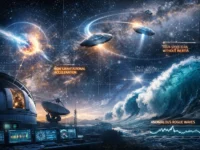
At the center of the mystery were what researchers now call anomalous motion events. Tracking systems recorded objects traveling at extraordinary speeds, stopping abruptly, reversing direction, and accelerating again. Under normal physics, such movement would destroy any known material. The forces involved would produce heat signatures, sonic disturbances, or structural stress.
None were detected.
Inertia, one of the most fundamental principles of physics, states that mass resists changes in motion. Yet these objects behaved as though inertia had temporarily vanished. They moved as if weight and resistance did not apply.
Independent radar systems observed identical maneuvers. Infrared imaging confirmed the absence of exhaust or thermal output. Optical tracking matched radar data precisely. When multiple independent systems detect the same anomaly, the likelihood of error becomes extremely small.
Scientists rechecked calibration logs, environmental interference, and known aerospace activity. The results remained unchanged. The data was real, and the explanation was missing.
The Interstellar Object That Refused to Behave
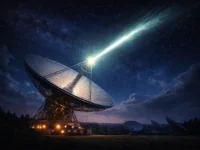
While researchers examined atmospheric anomalies, astronomers were tracking an interstellar object passing through our solar system. Normally, such objects follow predictable gravitational paths shaped by the Sun. This one did not.
Its trajectory showed non-gravitational acceleration, meaning it changed speed and direction in ways gravity alone could not explain. In many comets, gas escaping from the surface can act like a natural thruster. However, in this case, the motion did not match observable gas release.
The acceleration appeared smoother and more controlled than natural outgassing. Astronomers evaluated solar radiation pressure, rotational instability, and internal fragmentation, but none fully explained the movement. While no scientist declared the object artificial, several acknowledged that its behavior raised difficult questions.
The Ocean Event That Confused Scientists
The mystery extended beyond space. Satellite altimeters monitoring the Pacific Ocean detected massive waves forming suddenly in calm conditions. These were not storm-driven surges or seismic tsunamis. Weather systems showed stable conditions, yet enormous waves appeared in clusters, moving against prevailing currents.
Oceanographers reviewed the data carefully. The waves formed too quickly and too uniformly to match known rogue wave models. The energy displacement suggested a force that had not produced the usual signs of atmospheric disturbance or underwater seismic activity.
Taken alone, each anomaly might have been dismissed. Together, they formed a pattern that demanded attention.
Why We Are Seeing This Now
The universe may not have changed. Our ability to observe it has.
Modern science now uses highly advanced systems that monitor reality with extraordinary precision. Artificial intelligence merges radar, optical, and thermal data instantly. Motion tracking detects subtle shifts invisible to earlier instruments. Neutrino observatories capture particles that pass through matter undetected. Space telescopes measure gravitational interactions across vast distances.
With multiple independent systems observing the same event, misinterpretation becomes less likely. The anomalies are not simple noise. They represent real observations that challenge existing theory.
Could This Be New Physics
Throughout history, physics has evolved when evidence demanded it. Newton described gravity until Einstein revealed spacetime. Classical mechanics explained motion until quantum physics revealed deeper complexity. Scientific progress often begins with uncomfortable questions.
Some physicists now wonder whether these anomalies reveal undiscovered properties of space itself. Perhaps inertia behaves differently under certain conditions. Perhaps energy can transfer in ways not yet understood. Perhaps there exists a deeper layer of interaction beyond current models.
These ideas remain unconfirmed, but the anomalies suggest something fundamental may be incomplete in modern physics.
Why Scientists Remain Careful
Despite the strange observations, researchers are cautious. Scientific revolutions require overwhelming evidence. Before rewriting physics, scientists must eliminate conventional explanations such as sensor interference, data misinterpretation, unknown natural phenomena, or classified human technology.
Science advances through verification, not speculation. Until every standard explanation is ruled out, the anomalies remain unexplained rather than revolutionary.
What This Could Mean for Humanity
If future research confirms new physical principles, the consequences could be profound. A deeper understanding of motion and energy could transform propulsion, space exploration, and energy technology. History shows that breakthroughs often begin as mysteries. Electricity once seemed mysterious, and gravity once seemed invisible.
Today’s unexplained observation may become tomorrow’s scientific foundation.
For now, the truth remains simple. The universe has presented data that does not fully align with existing theory. The evidence is real, but the explanation remains unknown. And that is where discovery begins.
Frequently Asked Questions
Is this proof of unknown intelligence
The current evidence does not confirm intelligence. The observations show unexplained motion and energy behavior, but natural explanations may still emerge.
Could the instruments be wrong
Multiple independent systems recorded similar data. While errors are always considered, consistent cross-platform observations reduce the likelihood of simple malfunction.
What is non-gravitational acceleration
It refers to motion that cannot be explained by gravity alone. In many space objects, gas release can cause this effect, though recent observations do not fully match that explanation.
Why is this not constant global headline news
Scientific discoveries require careful verification and peer review. Researchers avoid dramatic claims until conventional explanations are thoroughly examined.
Could this lead to revolutionary technology
If new physical principles are eventually confirmed, technological advances could follow. At present, the investigation remains ongoing.
Important Disclaimer
This article discusses ongoing scientific observations and anomalous data reported in early 2026. The term “impossible” refers to behavior that challenges current scientific understanding, not confirmed violations of natural law. Research is ongoing, and conclusions may evolve as new evidence emerges. This content is for informational purposes only.
Proof of Incident and Reference Sources
Galileo Project Research Initiative
https://projects.iq.harvard.edu/galileo/home
Journal of Astronomical Instrumentation Scientific Study
https://www.worldscientific.com/doi/10.1142/S2251171723400068
NASA High Energy Astrophysics Science Archive
https://heasarc.gsfc.nasa.gov
Nature Journal Physics Research
https://www.nature.com
NOAA Ocean Monitoring and Satellite Data
https://www.noaa.gov

0 Comments