


Introduction: History’s Quietest Alarms
The world did not hear the sirens.
Cities did not evacuate. Governments did not issue public warnings. And yet, on more than one occasion, global civilization came within minutes — sometimes seconds — of nuclear war.
These moments were not hypothetical. They were real, documented, and confirmed long after the danger passed. What prevented catastrophe was not superior technology or flawless systems, but something far less predictable: human judgment under extreme pressure.
What makes these stories unsettling is not how dramatic they were — but how ordinary they appeared at the time.
The Cuban Missile Crisis: Thirteen Days on a Knife Edge
In October 1962, the United States discovered Soviet nuclear missiles being installed in Cuba, just 90 miles from Florida. What followed was the most dangerous confrontation of the Cold War.
For nearly two weeks, both superpowers prepared for nuclear conflict. Military forces were placed on high alert. Submarines armed with nuclear weapons moved silently beneath the Atlantic.
At one point, a Soviet submarine commander believed war had already begun and prepared to launch a nuclear torpedo. Only the refusal of one officer aboard prevented it.
President John F. Kennedy later admitted:
“It is insane that two men, sitting on opposite sides of the world, could decide to bring an end to civilization.”
The crisis ended with secret negotiations — not military victory.
1983: The Computer That Almost Started a War
On September 26, 1983, a Soviet early-warning system reported that U.S. nuclear missiles were inbound.
Alarms blared. Screens flashed. Protocol demanded immediate retaliation.
The officer on duty, Stanislav Petrov, noticed inconsistencies. Only a few missiles appeared — not the full-scale attack expected in a first strike.
Petrov made a decision that violated procedure. He labeled the alert a false alarm and did nothing.
He was right.
The system had misinterpreted sunlight reflecting off clouds. Had he followed protocol, the response could have been irreversible.
Years later, Petrov reflected:
“I had a funny feeling in my gut. I trusted it.”
When Training Exercises Look Like Real War
In November 1983, NATO conducted a military exercise known as Able Archer. It simulated the procedures for nuclear release.
Soviet intelligence misread the exercise as preparation for an actual strike.
Nuclear forces were quietly put on alert. Aircraft were armed. Missiles were prepared.
Western leaders did not realize how close the situation had come to spiraling out of control until years later, when Soviet archives were declassified.
The danger came not from aggression — but misunderstanding.
The Parallel Reality of Nuclear Command
Public life continued during these moments. People went to work. Children went to school. The world felt stable.
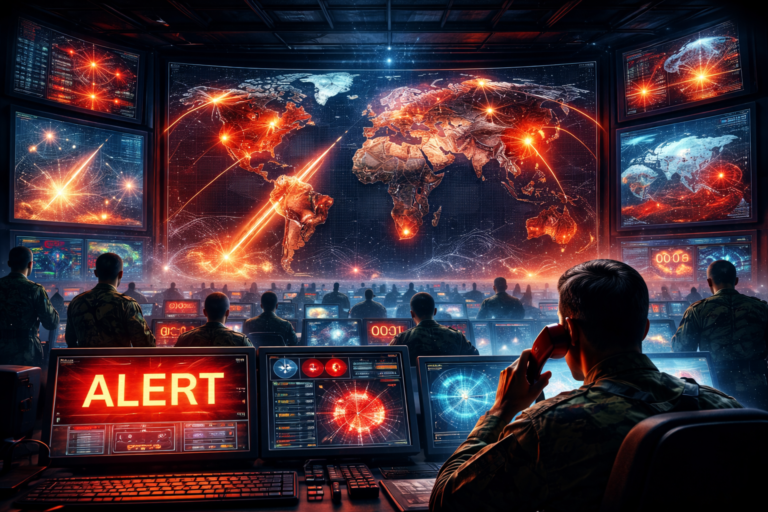
At the same time, another reality existed — one governed by classified briefings, blinking consoles, and countdown clocks.
In that parallel layer, decisions were measured in minutes. Information was incomplete. Consequences were absolute.
Both realities existed at once.
Most people never knew how thin the line was.
False Alarms, Human Error, and Narrow Escapes
Near-misses did not end with the Cold War.
- In 1979, a training tape mistakenly loaded into a U.S. defense computer indicated a massive Soviet attack.
- In 1995, a Norwegian scientific rocket was briefly mistaken by Russian radar as a possible nuclear launch.
- In multiple cases, miscommunication or outdated data nearly escalated routine events into crises.
Each time, restraint prevailed — not because systems worked perfectly, but because someone paused.
A former nuclear strategist once said:
“The world survived the nuclear age more by luck than design.”
Why These Incidents Still Matter
Some assume nuclear danger belongs to the past. It does not.
Thousands of nuclear weapons remain on high alert worldwide. Decision timelines are still measured in minutes. Automation has increased, not decreased.
The same risks persist:
- False signals
- Cyber interference
- Human fatigue
- Political miscalculation
What has changed is visibility. Today’s world is faster, louder, and less forgiving of delay.
The Illusion of Control
Nuclear systems are often described as precise, disciplined, and secure.
History tells a more complicated story.
Technology fails. Humans misjudge. Information arrives incomplete. And under pressure, the margin for error shrinks rapidly.
The real danger has never been intent alone — it has been assumption.
Lessons That Are Easy to Forget
The common thread across near-misses is not hostility. It is interpretation.
Each moment depended on someone choosing caution over certainty.
Yet many of the safeguards that prevented disaster were informal — instincts, doubts, second thoughts.
Those cannot be automated.
FAQs
How many times has nuclear war almost happened?
Multiple documented incidents occurred during and after the Cold War, involving false alarms and misinterpretation.
Were leaders aware at the time?
Often, no. Many details emerged years later through declassified records.
Are nuclear weapons still on high alert?
Yes. Several countries maintain rapid-launch capabilities.
Has technology reduced the risk?
Technology improves detection but also introduces new failure points.
Could it happen again?
Experts agree the risk has not disappeared.
Final Perspective
The most dangerous moments in nuclear history were not loud or visible. They happened quietly, behind closed doors, during ordinary days.
The world survived not because systems were flawless, but because individuals hesitated — questioned — and chose restraint.
That reality should not inspire fear.
It should inspire vigilance.
Because history shows that the line between peace and catastrophe has often been thinner than anyone realized.
References
- U.S. National Security Archive declassified nuclear records
- Cuban Missile Crisis transcripts and memoirs
- Soviet early-warning system documentation
- NATO Able Archer exercise analyses
- Peer-reviewed studies on nuclear command-and-control failures

0 Comments