


Introduction: Signals from a World We Rarely See
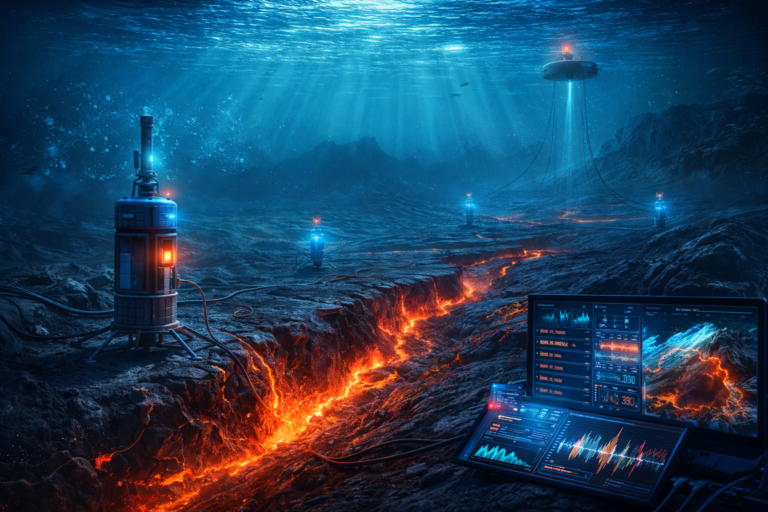
Thousands of meters below the Pacific Ocean’s surface, where sunlight never reaches and pressure crushes steel, a quiet network of sensors has been listening to the Earth.
Recently, those instruments have noticed something unusual.
Not an explosion. Not a quake strong enough to shake cities. But movement — slow, persistent, and spreading across regions that rarely draw public attention.
To scientists who study the deep ocean and the planet’s interior, these signals are not cause for alarm. But they are enough to pause, compare data, and ask careful questions.
Because when something moves beneath the seafloor, it rarely does so without reason.
What the Sensors Are Detecting
The Pacific Ocean hosts one of the world’s most advanced deep-sea monitoring systems. These sensors track:
- Seafloor vibrations
- Pressure changes
- Temperature fluctuations
- Subtle shifts in underwater terrain
In recent monitoring cycles, instruments have recorded low-frequency motion patterns that do not match typical earthquakes or known tectonic noise.
The signals appear gradual rather than sudden, suggesting slow processes rather than violent events.
A marine geophysicist familiar with the readings explained:
“This isn’t a single event. It’s movement over time, and that’s what makes it interesting.”
Where This Is Happening
The activity has been detected in parts of the Pacific known for geological complexity — regions shaped by tectonic plates sliding, sinking, and reshaping the planet’s crust.
Much of the Pacific sits atop the so-called “Ring of Fire,” where massive plates collide and dive beneath one another. Beneath that boundary lies a world in constant motion.
But the current signals appear different from typical seismic patterns, which tend to arrive sharply and fade quickly.
Instead, this movement seems measured, spreading, and quiet.
The Parallel Reality Beneath the Ocean Floor
On the surface, the Pacific looks unchanged. Ships cross it daily. Storms come and go. Satellites see nothing unusual.
Below, another reality unfolds.
Molten rock shifts slowly. Fluids migrate through fractures. Entire sections of Earth’s crust flex and settle without a sound reaching the surface.
This hidden world operates on timescales humans rarely notice — years, decades, centuries.
Both realities exist at once.
Most of the time, they never intersect.
Possible Explanations Scientists Are Exploring
Researchers emphasize that several well-understood processes could explain the movement.
Tectonic Plate Adjustment
Plates do not move smoothly. They lock, creep, release, and resettle. Slow-slip events can occur without triggering noticeable earthquakes.
Magma Migration
In volcanic regions, magma can move beneath the crust without erupting. Sensors often detect these shifts long before any surface activity.
Fluid Movement
Water and gas trapped deep underground can migrate through rock layers, creating pressure changes detectable by sensitive instruments.
Sediment Compaction
Over time, thick layers of sediment slowly compress and shift, especially along continental margins.
None of these explanations imply an imminent disaster.
Why Scientists Are Paying Attention Anyway
What makes the current readings notable is consistency.
The movement appears across multiple sensors, persists over time, and does not match background noise patterns scientists are accustomed to filtering out.
That does not mean danger. It means data worth studying.
A researcher involved in ocean monitoring put it simply:
“When the deep ocean does something new, the first step isn’t fear — it’s patience.”
How Modern Sensors Changed the Conversation
Until recently, much of the deep ocean was effectively invisible.
Today’s instruments can detect movements smaller than a human heartbeat occurring kilometers beneath the seabed.
That sensitivity means scientists now see processes that were always happening — just never measured before.
This has changed public perception.
Events once unnoticed now feel mysterious, not because they are new, but because they are newly visible.
Is This Linked to Earthquakes or Tsunamis?
At present, there is no evidence connecting the detected movement to earthquake activity or tsunami risk.
Earthquakes generate sharp, distinct seismic signatures. Tsunamis require sudden displacement of large water volumes.
The observed movement is slow and diffuse — the opposite of what produces immediate surface hazards.
Monitoring continues precisely to ensure that any change in behavior is detected early.
Why Stories Like This Capture Attention
The deep ocean occupies a unique place in the human imagination.
It is vast, dark, and largely unexplored. When instruments report motion beneath it, the mind fills gaps faster than science does.
But curiosity does not require fear.
In many cases, deeper understanding replaces mystery with appreciation for how dynamic the planet truly is.
What Happens Next
Scientists will continue to:
- Compare historical sensor data
- Cross-check readings with satellite measurements
- Monitor for changes in speed or direction
- Share findings through peer-reviewed analysis
This process unfolds quietly and deliberately. No announcements are made unless evidence demands it.
That is how Earth science typically works — slowly, carefully, and without drama.
FAQs
What exactly is moving under the Pacific?
Sensors detect motion within Earth’s crust or upper mantle, not objects or creatures.
Is this dangerous?
There is no indication of immediate risk based on current data.
Why didn’t we notice this before?
Earlier technology lacked the sensitivity to detect slow, deep movement.
Could this be volcanic activity?
Possibly, but no surface or eruption indicators have appeared.
Are scientists concerned?
They are attentive, not alarmed.
Final Perspective
The Pacific Ocean covers more than a third of the planet. Beneath it lies a constantly evolving landscape shaped by forces older than humanity itself.
The sensors are not warning bells.
They are reminders — that Earth is alive with motion, even when the surface feels still.
What feels mysterious today often becomes routine understanding tomorrow.
The planet has always been moving.
We are just getting better at listening.
References
- National Oceanic and Atmospheric Administration (NOAA) Ocean Monitoring Programs
- U.S. Geological Survey (USGS) Seafloor Geophysics Reports
- Woods Hole Oceanographic Institution Deep-Sea Sensor Research
- International Ocean Discovery Program (IODP) Publications
- Peer-reviewed studies on slow-slip tectonic events

0 Comments