


Introduction: A Warning from the Sun
Far beyond Earth’s atmosphere, something restless is unfolding.
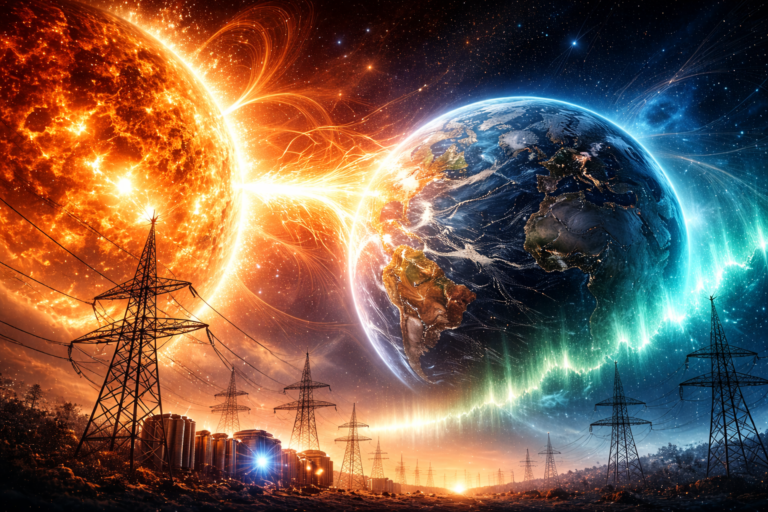
Scientists who monitor the Sun have detected signs of a developing solar storm — a surge of charged particles racing through space at extraordinary speed. Most of the time, these events pass harmlessly. Sometimes, they do not.
This one is being watched with unusual care.
Space weather centers, satellite operators, and power grid managers are paying attention because if the storm aligns just right, it could interfere with electrical systems on Earth. Not everywhere. Not all at once. But enough to matter.
There is no panic. There is preparation.
What Is This Solar Storm?
Solar storms begin with eruptions on the Sun’s surface, often linked to sunspots and magnetic instability. When the Sun releases a burst of plasma and magnetic energy, that material can travel millions of kilometers toward Earth.
If it reaches the planet and interacts with Earth’s magnetic field, the result is a geomagnetic storm.
These storms vary widely in strength. Some create nothing more than beautiful auroras. Others strain satellites, scramble radio signals, and place stress on power grids.
According to a space weather researcher involved in monitoring the event:
“The question isn’t whether the Sun will erupt. It’s whether the timing and orientation line up to affect us.”
Why This Storm Has Scientists Paying Attention
Several factors make this event notable:
- The eruption was fast-moving
- The magnetic structure appears complex
- Earth is currently in a phase of heightened solar activity
- Critical infrastructure is more interconnected than ever
Solar cycles peak roughly every 11 years, and current observations suggest the Sun is entering a more active phase sooner and stronger than earlier forecasts predicted.
That does not guarantee damage. But it raises the stakes.
The Hidden Vulnerability of Modern Power Grids
Power grids are among the most sensitive systems during strong geomagnetic storms.
When charged particles interact with Earth’s magnetic field, they induce electrical currents in long transmission lines. These currents were not part of the grid’s original design.
The effects can include:
- Transformer overheating
- Automatic shutdowns to prevent damage
- Voltage instability
- Temporary blackouts
In extreme cases, repairs can take weeks or months.
A grid engineer once explained it this way:
“The grid was built for weather on Earth, not weather from space.”
Parallel Reality: Calm on the Surface, Tension Behind the Scenes
On the ground, life looks normal. Lights turn on. Phones charge. Trains run on time.
Above the atmosphere, a different reality is unfolding.
Satellites adjust their orientation. Space agencies reroute missions. Power operators quietly move into monitoring mode. Alerts circulate through systems most people never see.
Two realities exist at once — one familiar, one invisible.
Most of the time, they never collide.
What Could Happen If the Storm Hits Directly?
If the storm reaches Earth with the right magnetic alignment, several effects are possible:
Power Systems
Localized power disruptions could occur, particularly at higher latitudes where geomagnetic effects are stronger.
Satellites
Increased radiation can interfere with onboard electronics and force operators to place satellites into safe modes.
Communications
High-frequency radio signals may degrade, affecting aviation and maritime communications.
Navigation
GPS accuracy can temporarily drop, especially for precision-dependent systems.
It is important to note that none of these outcomes are guaranteed. Forecasting space weather remains complex.
Lessons from Past Solar Storms
History offers perspective.
In 1989, a geomagnetic storm triggered a widespread power outage in parts of North America. In 1859, a far stronger event caused telegraph systems to spark and fail across continents.
Those events occurred in a world far less dependent on electronics than today.
Modern systems are more resilient — but also more interconnected.
Why Early Tracking Matters
The advantage humanity has today is time.
Space-based observatories can detect eruptions shortly after they occur. That gives grid operators hours or even days to prepare.
Preparation includes:
- Reducing power load on vulnerable equipment
- Adjusting satellite operations
- Issuing alerts to aviation and maritime sectors
This preparation does not stop the storm. It reduces its impact.
As one space weather analyst put it:
“Forecasting won’t control the Sun, but it gives us options.”
Should the Public Be Worried?
At this stage, concern should remain measured.
Scientists track many solar storms every year. Most pass without serious consequence. Public communication emphasizes readiness, not fear.
The real story is not catastrophe — it is coordination.
Governments, researchers, and infrastructure operators are quietly rehearsing responses to events that once arrived without warning.
FAQs
What is a solar storm?
A solar storm is a burst of energy and charged particles released by the Sun that can interact with Earth’s magnetic field.
Can solar storms really cause blackouts?
Yes, in rare but documented cases. Strong storms can induce currents that disrupt power systems.
Are smartphones and home electronics at risk?
Individual devices are generally safe. Large-scale infrastructure is more vulnerable.
How much warning do scientists get?
Depending on the storm, anywhere from several hours to a few days.
Is this storm confirmed to hit Earth?
No. Scientists are tracking probabilities, not certainties.
Final Perspective
The Sun is not hostile. It is active.
Most of the time, Earth’s magnetic field shields the planet quietly and effectively. Occasionally, the balance is tested.
This solar storm is not a signal of collapse. It is a reminder — that life on Earth exists within a broader cosmic environment, shaped by forces far beyond the horizon.
We may not see the storm.
But the systems we depend on certainly feel it.
References
- National Oceanic and Atmospheric Administration (NOAA) Space Weather Prediction Center
- NASA Heliophysics Division Solar Activity Reports
- European Space Agency Space Weather Programme
- National Academies of Sciences on Space Weather Impacts
- Peer-reviewed geomagnetic storm case studies

0 Comments