

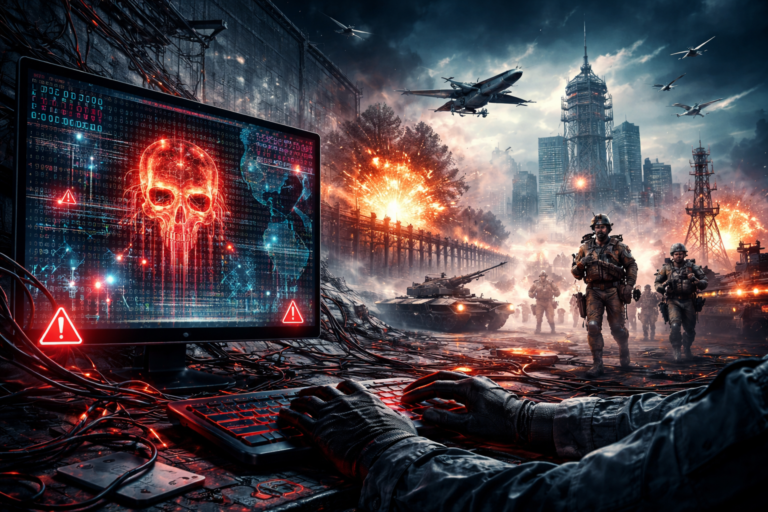

Introduction: The War You Never See Coming
There are no fighter jets overhead. No missiles on the horizon. No warning sirens.
And yet, nations are under attack.
Power grids go dark. Hospitals lose access to patient records. Stock markets freeze. Airports shut down. Communication systems collapse. The damage is real, immediate, and sometimes irreversible.
This is the new battlefield.
Around the world, governments are now openly stating what security experts have warned for years: a large-scale cyberattack can be treated the same way as a military strike. In some cases, it may even justify a physical response.
The line between war and peace has blurred into something far more unsettling.
The Turning Point: From Crime to Combat
For years, cyberattacks were treated as espionage, vandalism, or sophisticated theft. Hackers were criminals. States denied involvement. Responses were quiet and diplomatic.
That era is over.
Military alliances and defense departments now classify certain cyber incidents as armed aggression if they meet specific thresholds: loss of life, severe economic disruption, or long-term damage to critical infrastructure.
A senior NATO official once stated:
“If a cyberattack shuts down a hospital or disables a nation’s power supply, the consequences are no different from a missile strike.”
That statement was not symbolic. It reflected a policy shift already underway.
Why This Escalation Is Happening Now
1. Cyberattacks Are No Longer Abstract
Early hacks targeted data. Modern attacks target systems that keep societies running.
Water treatment facilities. Emergency dispatch centers. Nuclear plants. Air traffic control. Election infrastructure.
When code can cause planes to ground or patients to die, the distinction between digital and physical violence collapses.
2. Attribution Has Improved
Governments once hesitated because they could not prove who launched an attack. Today, digital forensics, intelligence sharing, and pattern analysis make state involvement harder to deny.
While attribution is rarely made public in full detail, decision-makers are far more confident behind closed doors.
3. Deterrence Failed
Quiet diplomacy did not stop escalation. Sanctions barely slowed it. Cyber operations became bolder, more destructive, and more frequent.
Treating cyberattacks as acts of war is meant to restore deterrence by raising the cost.
Parallel Reality: Living in Two Worlds at Once
Here is the unsettling truth: we are already living in a form of parallel reality, without ever calling it that.
In one world, life continues normally. People commute, shop online, stream movies, and trust that systems will work tomorrow as they did today.
In the other world, invisible conflicts rage nonstop. Code battles code. States probe each other’s defenses daily. Digital weapons are tested silently, waiting for the moment they are needed.
These worlds exist simultaneously, layered on top of each other.
Most civilians never see the second one—until it breaks through.
How Militaries Are Redefining “Attack”
Defense doctrines now include cyber operations alongside land, sea, air, and space.
A cyberattack may be considered an act of war if it:
- Causes deaths or serious injuries
- Cripples critical infrastructure
- Creates long-term economic damage
- Disrupts military command and control
- Undermines democratic systems at scale
What matters is not the tool used, but the impact.
As one defense analyst put it:
“The keyboard has become a launch platform.”
The Risk of Miscalculation
This shift carries enormous danger.
Cyber operations are often ambiguous. Attacks can be masked, reused, or falsely attributed. A misjudgment could trigger retaliation against the wrong actor.
Even worse, cyber conflicts do not stay contained. Digital systems are interconnected across borders. A strike aimed at one country can spill into dozens of others within minutes.
Escalation can happen faster than diplomacy can respond.
Civilians Are Now on the Front Line
Unlike traditional wars, cyber conflicts do not stop at military targets.
Hospitals, banks, schools, media outlets, and transportation systems are often easier to breach—and more disruptive to hit.
This reality raises uncomfortable questions:
- Who protects civilians in a cyber war?
- What counts as a war crime in digital space?
- How do nations defend societies that rely on fragile networks?
There are no clear answers yet.
What This Means for the Future
Treating cyberattacks as acts of war signals a fundamental change in how power is exercised.
Nations are investing heavily in:
- Offensive cyber capabilities
- Cyber command units within armed forces
- Digital defense of civilian infrastructure
- Cyber alliances and shared intelligence
The world is not moving away from conflict. It is moving into a quieter, faster, and less visible form of it.
And unlike traditional war, this one never sleeps.
FAQs
Are all cyberattacks considered acts of war?
No. Most cyber incidents are still treated as crime or espionage. Only attacks causing severe national harm may cross the threshold.
Can a cyberattack justify military retaliation?
In some doctrines, yes. If the impact equals that of a physical attack, a state may respond using any domain it chooses.
Why don’t governments reveal evidence publicly?
Revealing technical details can expose intelligence methods and weaken future defenses.
Are civilians protected under international law in cyber war?
Existing laws are being adapted, but enforcement remains unclear and inconsistent.
Is this already happening?
Yes. Governments rarely announce responses, but cyber operations are already integrated into military planning.
Final Disclaimer
This article is based on publicly available defense policies, expert analysis, and official statements. Cyber warfare attribution and response decisions often involve classified intelligence not accessible to the public.
References
- NATO Cyber Defence Policy Statements
- U.S. Department of Defense Cyber Strategy Documents
- United Nations Group of Governmental Experts on Cybersecurity
- Center for Strategic and International Studies (CSIS) Cyber Conflict Reports
- Tallinn Manual on the International Law Applicable to Cyber Warfare

0 Comments