
















By Ronald Kapper
Disclaimer
This article summarises scientific studies, spacecraft missions, and ongoing research. Some aspects are not yet fully confirmed, and where appropriate, I describe uncertainty clearly. Reference URLs at the end let you explore the original sources yourself.
Introduction: The Ocean Hidden Beneath Ice That Keeps Scientists Up at Night
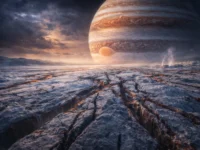
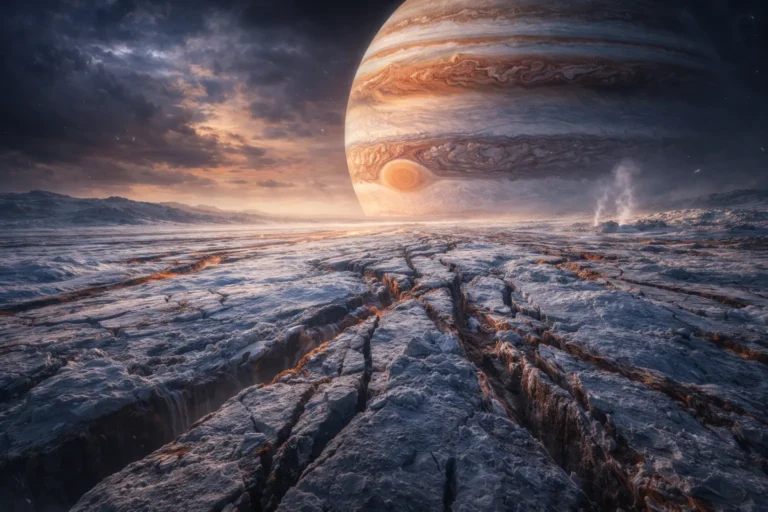
Imagine a world just slightly smaller than Earth’s Moon. Its surface is a frozen desert, etched with cracks and chaos. But beneath that icy shell might lie a vast, dark ocean — a sea larger than all of Earth’s oceans combined. This isn’t science fiction. It’s Europa, one of Jupiter’s biggest moons, and NASA’s latest findings are making this distant water world even more exciting to scientists and explorers. The reason? New clues suggest Europa’s ocean could have more features and ingredients that make it a compelling place to look for life beyond Earth.
Europa: An Ocean World in Plain Sight
When scientists first aimed powerful telescopes at Europa, they saw a bright, smooth world. Ice — everywhere you looked. But that same uniform face hid something profound: signs that water, in liquid form, exists below. Evidence from decades of missions and research shows that beneath an icy shell roughly ten to eighteen miles thick lies a global ocean of salty water. That ocean is estimated to be as much as forty to one hundred miles deep — possibly containing twice as much water by volume as all of Earth’s oceans combined.
This isn’t a small puddle. If you could somehow pull all of that liquid into one place, it could dwarf Earth’s seas. That alone makes Europa a prime focus in the hunt for environments that might support life.
NASA’s Galileo Mission: The First Signals of Something Big
Decades ago, NASA’s Galileo spacecraft orbiting Jupiter provided the first convincing evidence that Europa’s ice hid something unique. Scientists studying magnetometer readings from Galileo found odd magnetic signatures inconsistent with frozen rock alone. Instead, the most logical explanation was a layer of electrically conductive salty water beneath the surface. That discovery shifted Europa from being an interesting icy moon to being one of the most exciting water worlds in the solar system.
Plumes, Chemistry, and Water Exchange: Small Clues With Big Implications
More recent research has added layers to the mystery. Observations from powerful Earth-based telescopes and re-analysis of spacecraft data suggest there may be thin plumes of water vapor erupting above Europa’s icy crust. In 2019, a team using the Keck Observatory detected water vapor high above the surface — possibly from geyser-like eruptions connected to the hidden ocean below. If these plumes exist, future spacecraft might be able to directly sample ocean water without landing or drilling through the ice.
Another breakthrough comes from chemical signatures on Europa’s surface. Using data from space telescopes, scientists detected ammonia-bearing compounds — molecules that could indicate exchange between the ocean and surface. Ammonia is important because it changes the freezing point of water and could support more varied chemistry in the ocean below.
There are also hints of carbon dioxide concentrated in specific regions of Europa’s surface. Carbon is an essential element for life, and its presence near surface features that connect to the ocean suggests a deeper link between surface chemistry and ocean contents.
NASA’s Juno Probe: A New Glimpse Under Ice
While NASA prepares for future missions like Europa Clipper, the Juno spacecraft has already given us fresh insight. During a close flyby in 2022, Juno’s microwave radiometer measured Europa’s icy shell and found it to be around 29 kilometres thick in the region examined. That’s a much clearer picture than previous estimates, which ranged widely. Knowing the ice thickness is vital because it affects how heat moves through the shell, how cracks form, and how surface material might seed the ocean below.
This matters for habitability potential. If cracks and thinner areas exist, nutrient exchange between the surface and the ocean becomes more plausible — and that could be key for any life forms hoping to thrive in the depths.
Europa Clipper: The Next Giant Step
The Europa Clipper mission, launched in late 2024, marks a historic moment. This spacecraft is engineered to study Europa up close, making dozens of close flybys once it arrives in the Jupiter system in 2030. Its instruments will measure magnetic fields, surface composition, ice thickness, and more — all to build a detailed picture of the hidden ocean and the environment surrounding it.
One instrument, a magnetometer, will help confirm the depth and salinity of Europa’s ocean by precisely tracking how the moon’s magnetic field changes during flybys. Another instrument will map surface chemistry, seeking signs of organics and other key elements linked to life.
This mission is extraordinary not just for what it will see, but what it might find in terms of life-friendly conditions. Europan water may harbour mixtures of salts, nutrients, and energy gradients — all ingredients we consider essential for life on Earth.
Are There Any Challenges to Life on Europa?
Even with all this promise, scientists remain careful and honest about uncertainties. Some new research suggests Europa’s seafloor might lack the kind of tectonic activity found on Earth, which on our world helps recycle nutrients and provide energy for ocean life. If true, that doesn’t necessarily rule out life; it just means the environment might differ from Earth’s deep oceans.
Another challenge is that Europa’s icy shell might be thick and rigid in places, potentially limiting how easily surface materials mix into the ocean. That could make the ocean less nutrient-rich than some hoped.
Yet even in Earth’s most extreme environments, life finds a way. Hydrothermal vents deep beneath our oceans support rich ecosystems without sunlight. Europa’s ocean may not mirror Earth’s, but it could still surprise us.
What This Means for the Search for Life
Europa has become a top priority in the search for life beyond Earth because it checks a lot of boxes: lots of liquid water, chemical diversity, and potential energy sources. The new NASA findings sharpen our picture and push the idea that this ocean isn’t just a curiosity — it’s a real laboratory for astrobiology.
If future missions confirm that Europa’s ocean has the right chemistry and active mixing environments, it could be one of the most promising places to find signs of life in our solar system — not millions of light-years away, but right in our celestial backyard.
FAQs
Q: Does Europa really have an ocean?
A: Yes. Multiple lines of evidence — from spacecraft magnetometers to surface features and chemistry — strongly suggest a global ocean beneath the ice.
Q: Is the ice shell thick or thin?
A: Latest measurements indicate the frozen shell may be about 29 kilometres thick in some areas.
Q: Could life exist there?
A: Scientists believe the ingredients for life could be present, but whether life actually exists is still unknown. Mission data from Europa Clipper will help answer that.
Q: Why is NASA so focused on Europa?
A: Europa’s vast water ocean, chemical diversity, and possible energy sources make it one of the most promising places to search for life beyond Earth.
References — Proof and Source URLs
- NASA Science: Evidence for Europa’s Ocean — https://science.nasa.gov/mission/europa-clipper/why-europa-evidence-for-an-ocean/
- NASA Science: Europa Facts and Ocean Depth — https://science.nasa.gov/jupiter/jupiter-moons/europa/europa-facts/
- NASA Blog: Ammonia on Europa — https://science.nasa.gov/blogs/science-news/2026/01/29/nasas-galileo-mission-points-to-ammonia-at-europa-recent-study-shows/
- NASA Juno Finds Ice Thickness — https://www.jpl.nasa.gov/news/nasas-juno-measures-thickness-of-europas-ice-shell/
- NASA Europa Clipper Mission Overview — https://science.nasa.gov/mission/europa-clipper/
- Tara Regio Chemistry Insights — https://en.wikipedia.org/wiki/Tara_Regio
- Europa Clipper Instrument Details — https://en.wikipedia.org/wiki/Europa_Clipper_Magnetometer

0 Comments