

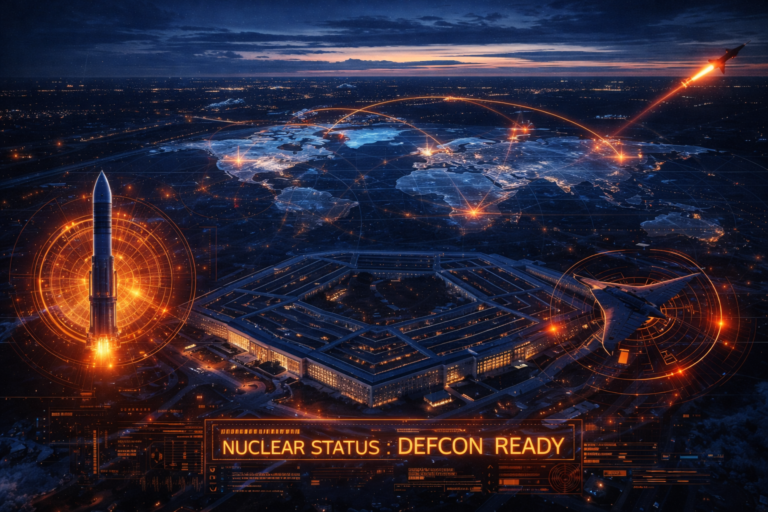

At 7:30 a.m. Eastern Time on January 17, 2025, a brief update quietly appeared in a Department of Defense directive. No press conference followed. No dramatic announcement was made.
Yet within strategic circles, the reaction was immediate.
The Pentagon had revised how nuclear forces are classified, maintained, and prepared — not by adding weapons or raising alert levels, but by changing the rules that define readiness itself.
On paper, the update looked technical.
In practice, it reshaped how deterrence works in the modern era.
What Changed — Without Saying It Loudly
The revised framework adjusts how nuclear forces move between readiness states. Previously, readiness was measured primarily by time-to-launch and system availability.
The new language emphasizes:
- Continuous operational flexibility
- Distributed command survivability
- Adaptive response postures
In simpler terms, readiness is no longer about how fast weapons can be used — it’s about how resilient decision-making remains under pressure.
A former Strategic Command advisor, speaking privately after the update, summarized it this way:
“Speed mattered in the Cold War. Survival matters now.”
That sentence captures the shift.
Why the Timing Matters
The update did not happen in isolation.
Between October 2024 and January 2025, multiple geopolitical developments increased pressure on long-range deterrence systems. Hypersonic weapons testing, electronic warfare advances, and space-based surveillance have altered how early warning and response timelines function.
On December 3, 2024, during a closed-door defense briefing, a senior official reportedly warned that traditional readiness models were “too linear for modern conflict.”
The January update appears to be the policy response to that warning.
Readiness Without Escalation
One of the most important elements of the change is what it does not do.
- It does not raise alert levels
- It does not shorten launch authority timelines
- It does not signal imminent use
Instead, it introduces layered readiness, allowing forces to remain credible without being visibly escalatory.
That matters in a world where misinterpretation can be as dangerous as intent.
A defense policy analyst noted during a February 2025 security forum:
“You can be ready without looking nervous. That’s the balance this tries to strike.”
A Shift From Hardware to Systems Thinking
Historically, nuclear readiness focused on platforms: missiles, submarines, bombers.
The revised framework treats readiness as a system, not a stockpile.
Key emphasis areas include:
- Communication continuity under cyber stress
- Redundant command pathways
- Human decision integrity under compressed timelines
In other words, the Pentagon is preparing less for a single catastrophic moment and more for extended uncertainty.
Same weapons.
Different mindset.
Why This Feels Like Two Eras Overlapping
Publicly, nuclear policy still speaks the language of deterrence stability and restraint.
Internally, planning now assumes:
- Partial information
- Disrupted communications
- Ambiguous threat signals
Those two realities coexist.
Nothing looks different from the outside. Forces remain in place. Procedures appear unchanged.
But underneath, the rules that define “ready” have been rewritten.
That’s why experts describe the shift as structural rather than dramatic.
What Officials Are Saying — Carefully
Pentagon statements emphasize continuity.
During a press briefing on January 22, 2025, a defense spokesperson described the update as “routine doctrinal refinement.”
That wording is technically accurate.
It’s also deliberately understated.
A retired senior officer familiar with nuclear command structures commented afterward:
“Routine doesn’t mean small. It means deliberate.”
Why This Isn’t Front-Page News
Because nothing exploded.
Nothing moved visibly.
Nothing crossed a red line.
Policy changes that prevent crises rarely attract attention. But they often matter more than reactive measures.
This update is about avoiding worst-case scenarios, not preparing for headlines.
And prevention, by design, is quiet.
The Strategic Logic Behind the Change
Modern conflict doesn’t begin with launches. It begins with uncertainty.
Cyber interference, space asset disruption, and information fog can all distort early warning systems. The new readiness model assumes those distortions are likely, not hypothetical.
By prioritizing resilience over speed, the Pentagon is betting that clear thinking under pressure is the real deterrent.
That’s a philosophical shift — not a technological one.
Frequently Asked Questions
Does this mean the U.S. is closer to using nuclear weapons?
No. The update focuses on command resilience, not launch readiness.
Why change readiness rules now?
Because modern threats compress decision time and complicate information flow.
Are nuclear forces on higher alert?
No public alert level changes have been announced.
Does this affect allies?
Indirectly. Extended deterrence relies on credible, stable command structures.
Will there be more changes?
Likely. Defense doctrine evolves continuously in response to new conditions.
A Quiet Redefinition of “Ready”
The most important defense shifts don’t always involve new weapons or louder warnings.
Sometimes, they involve redefining what preparedness actually means.
The Pentagon’s January update didn’t announce a new era.
It acknowledged that the old one is already over.
Same arsenals.
Same deterrence goals.
A different understanding of readiness — designed for a world where the greatest threat isn’t speed, but confusion.
And in that space between calm and chaos, policy — not power — often makes the difference.

0 Comments