
















When Silence in the Cockpit Speaks Loudest
Commercial aviation is built on logic, discipline, and control. Every switch, every sound, every word spoken inside a cockpit is recorded for safety. Pilots are trained to remain calm under pressure, even in extreme emergencies. Their voices rarely reveal fear. They follow procedure. They trust instruments. They rely on data.
Yet, across decades of aviation history, there have been moments when experienced pilots encountered something they could not explain. Not rumors, not myths, but real events captured by cockpit voice recorders. These recordings preserve raw human reaction in real time — confusion, hesitation, and sometimes deep uncertainty.
Most mysterious encounters are eventually explained through science, weather analysis, or technical review. However, a handful remain unresolved even after detailed investigation. These cases continue to be studied, not because they prove anything extraordinary, but because unanswered questions in aviation are never ignored.
This article carefully presents documented incidents and verified recordings. Aviation remains extremely safe, and these events are rare. Where explanations are uncertain, they are presented responsibly.
The Night an Unknown Light Matched a Commercial Flight
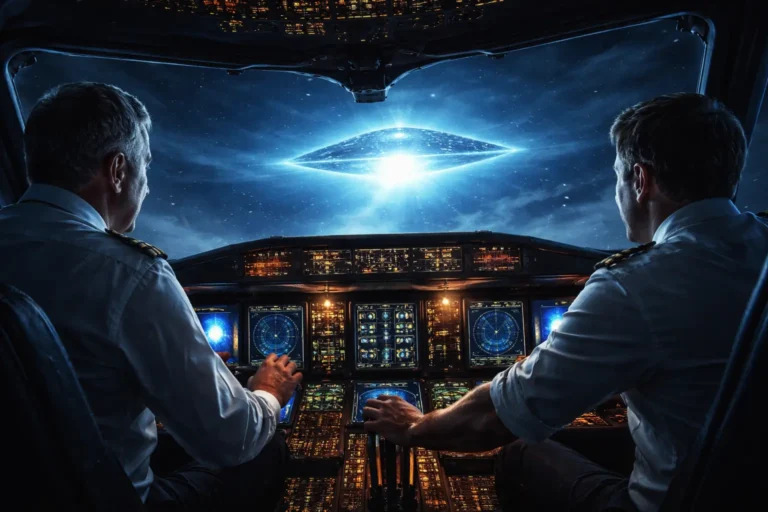
During a long overnight journey across open ocean, a commercial aircraft crew noticed a distant light moving parallel to their plane. At first, the captain assumed it was another aircraft at similar altitude. However, the onboard radar showed nothing nearby.
The cockpit recorder captured a calm but curious exchange. The co-pilot confirmed visual contact while the captain contacted air traffic control for confirmation. Controllers responded clearly — there was no traffic in the area.
For several minutes, the light maintained steady distance, almost mirroring the aircraft’s movement. Then suddenly, it accelerated upward at an impossible angle and disappeared.
The cockpit fell silent before the co-pilot finally spoke, admitting he had no explanation. Investigators later reviewed radar logs, satellite tracking, and weather conditions. No aircraft, drone, or atmospheric event could be confirmed in that position. The case was officially logged as unexplained due to insufficient data.
Events like this are rare, but they demonstrate how even trained observers can face moments beyond immediate understanding.
The Famous Alaska Encounter — A Case Still Studied
One of the most documented and widely analyzed incidents occurred in 1986, when a cargo flight flying over Alaska reported multiple unknown objects pacing the aircraft. The cockpit recording revealed calm yet increasingly puzzled voices describing unusual lights and a massive shape ahead.
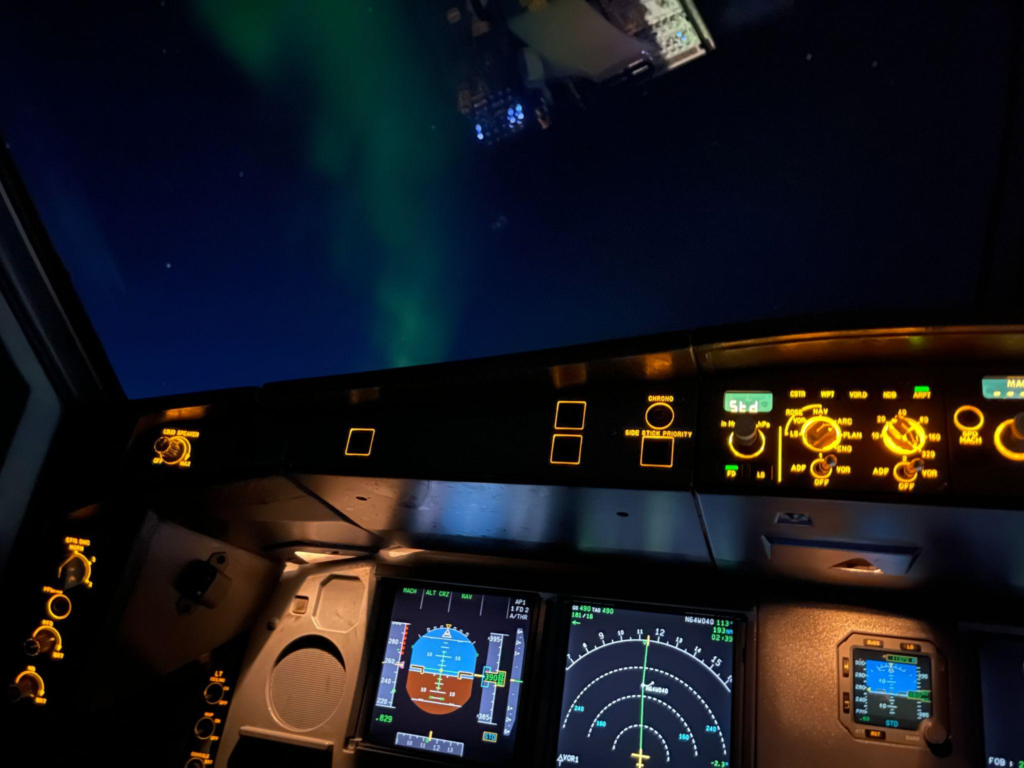
The captain described two bright objects initially, followed by what appeared to be a much larger structure-like form in front of the aircraft. Air traffic control first saw nothing, then briefly detected unknown radar returns matching the crew’s location.
The cockpit recording preserved a professional crew trying to reason logically through the situation. The captain compared speed, distance, and movement while remaining composed. The objects reportedly stayed near the aircraft for nearly half an hour before vanishing.
Investigators later analyzed radar data, atmospheric conditions, and satellite records. Some radar traces existed but could not be clearly identified. The case remains one of aviation’s most studied unexplained encounters because multiple systems — visual observation and partial radar detection — recorded something unusual.
Even today, aviation researchers revisit this case while studying pilot perception and sensor interpretation.
The Radar Echo That Appeared and Vanished
Another incident from European airspace involved a commercial aircraft detecting a solid radar echo directly ahead at the same altitude. The pilots requested traffic confirmation from air traffic control. Controllers saw no other aircraft nearby.
The cockpit recorder captured growing tension as the radar showed a clear object, yet onboard collision avoidance systems remained silent. Moments later, the echo vanished completely. It did not descend, climb, or move away. It simply disappeared.
Later analysis suggested unusual atmospheric layering might have created a radar reflection. However, engineers noted that the echo behaved differently from typical radar interference. The case was classified as unresolved, though not considered dangerous.
This incident became important in aviation research because it highlighted how radar systems can occasionally display signals that challenge known patterns.
A Mysterious Radio Voice in the Night Sky
On a late-night flight, pilots experienced a strange interruption on their communication frequency. The cockpit recorder captured faint but structured audio that did not match standard aviation transmission patterns.
The co-pilot attempted to identify the signal, calling for the unknown station to respond. There was no reply. The signal repeated once and then disappeared completely.
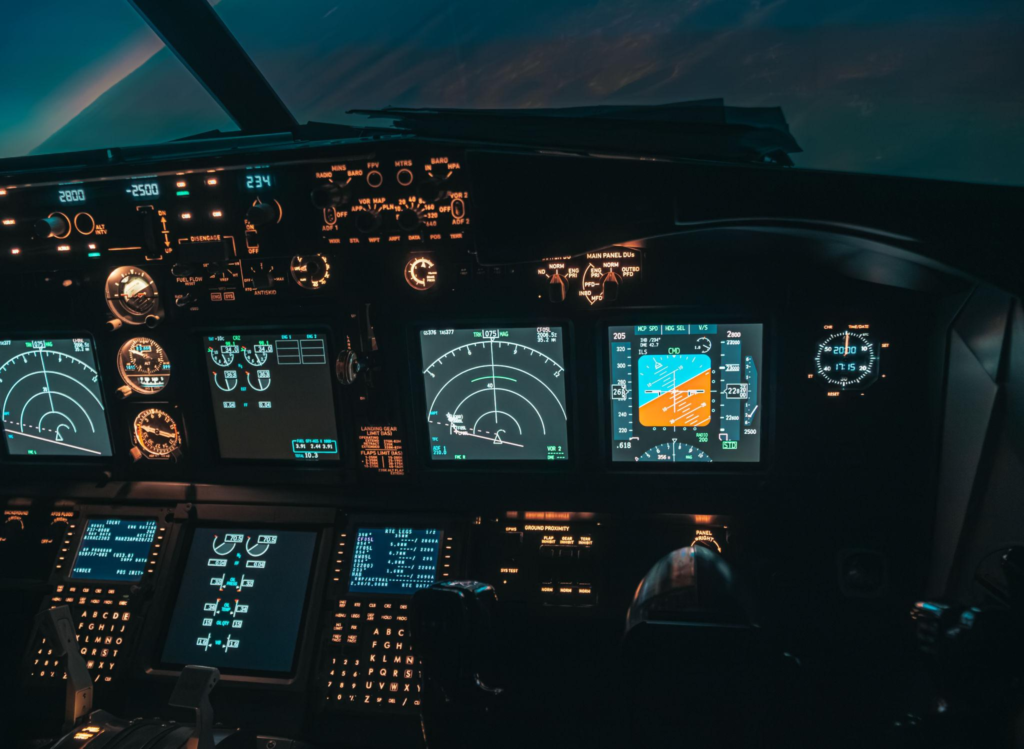
Technical analysis later confirmed the transmission did not match any registered aircraft, ground station, or satellite relay. Some experts suggested rare atmospheric radio reflection might have caused distant signals to bounce unexpectedly. However, the pattern of the transmission did not fully match known radio reflection behavior.
The recording remains archived as an unexplained communication anomaly, often discussed in aviation signal research.
When Calm Voices Reveal Hidden Unease
Cockpit voice recordings rarely capture fear. Pilots are trained to remain steady even in life-threatening situations. However, in some rare cases, voice analysis has revealed subtle signs of uncertainty — longer pauses, slower speech, and changes in tone.
In one Pacific incident, pilots described a fast-moving object passing beneath their aircraft at extreme speed. There was no radar contact, no sound, and no visible trail. The captain quietly remarked that the object did not behave like any known aircraft.
Later investigation suggested the object might have been space debris re-entering the atmosphere. However, no confirmed debris entry was recorded during that time window. The event remained classified as unidentified due to incomplete supporting data.
For aviation psychologists, this case became significant not because of what the pilots saw, but because experienced professionals rarely express uncertainty without cause.
Science Often Solves the Mystery
Many unexplained cockpit recordings eventually receive scientific explanations. Atmospheric plasma can produce glowing shapes in the sky. Temperature inversions can create radar ghosts. Space debris can move at extraordinary speed. Satellite reflections can confuse sensors. Human perception at high altitude can misjudge size and distance.
However, not every case is resolved. When evidence remains incomplete, investigators classify the event as an unidentified aerial observation. This does not confirm extraordinary origin. It simply means available data cannot produce a final conclusion.
Aviation science progresses by studying even the smallest anomaly, because every unknown may improve safety and understanding.
Why Aviation Experts Continue Studying These Recordings
Cockpit audio provides something rare — real human reaction during unexpected events. Researchers analyze these recordings to understand decision-making, stress response, and instrument interpretation under uncertain conditions. They also use them to improve radar systems, communication clarity, and anomaly detection technology.
Unexplained cases are not dismissed. They are archived, reviewed, and sometimes reanalyzed years later when better technology becomes available. Several once-mysterious incidents have eventually been solved decades after they occurred.
Because in aviation, unanswered questions are never ignored.
The Human Mind and the Unknown Sky
Most pilots who experienced unexplained encounters continued flying normally. They did not describe fear, but rather deep curiosity. Some referred to the moment as strange yet calm. Others described it as something beyond routine aviation experience.
Psychologists note that when highly trained observers cannot identify an event, the brain records it strongly. Not as panic, but as unresolved memory. This is why some cockpit recordings continue to fascinate aviation experts even years later.
Modern Technology Is Reducing the Unknown
Today’s aircraft carry far more advanced systems than those of earlier decades. High-precision radar, satellite tracking, digital flight recorders, and automated detection systems allow investigators to analyze events in far greater detail.
Because of this, unexplained encounters are becoming rarer. Many events that once seemed mysterious are now understood through improved data reconstruction. However, occasionally, new recordings still surface that challenge immediate explanation.
Not because something supernatural exists, but because nature and technology can sometimes behave in ways science has yet to fully decode.
Separating Verified Incidents from Fiction
The internet contains many exaggerated aviation stories. Real investigation relies only on verified cockpit recordings, radar data, and technical analysis. Only a very small number of cases remain unexplained after full scientific review.
Unidentified does not mean extraordinary. It means incomplete evidence. Aviation remains one of the safest systems ever created by humans.
The Sky Still Holds Questions
At cruising altitude, above clouds and far from ground reference, pilots sometimes witness events that challenge immediate understanding. Most are solved through science. Some remain debated. A few continue to puzzle investigators.
Cockpit voice recorders preserve those rare moments — calm professional voices facing something they cannot immediately explain. Not fear, not myth, but unanswered observation recorded in real time.
And in aviation, every unanswered question becomes a path toward deeper understanding.
Frequently Asked Questions
Many readers wonder whether cockpit recordings of unexplained encounters are genuine. Yes, several verified recordings exist in official aviation archives. Some were later explained through science, while a few remain unresolved due to limited data.
Another common question is whether these incidents prove unknown aerial phenomena. There is no confirmed proof. The term unidentified simply means not fully explained with available evidence.
People also ask if pilots frequently encounter strange objects. Such events are extremely rare compared to millions of safe flights conducted every year. Aviation remains highly secure and controlled.
Some readers wonder whether radar can produce false targets. Yes, atmospheric interference, temperature layering, and signal reflection can sometimes create temporary radar echoes.
Passengers often worry whether such incidents are dangerous. In nearly all recorded cases, flights continued safely with no threat to passengers or aircraft.
Disclaimer
This article is based on documented aviation reports, cockpit recording archives, and publicly discussed investigation cases. Some incidents remain unresolved due to incomplete data. The term unidentified does not imply supernatural origin, extraterrestrial involvement, or hidden activity. Aviation continues to be one of the safest and most advanced industries in the world.
Reference Sources and Incident Records
Japan Airlines Flight 1628 Investigation
https://www.narcap.org/reports
FAA Aviation Safety Archives
https://www.faa.gov/air_traffic/publications
NASA Aviation Safety Reporting System
https://asrs.arc.nasa.gov
UK Civil Aviation Authority Occurrence Database
https://www.caa.co.uk
National Transportation Safety Board Records
https://www.ntsb.gov

0 Comments