
















By Ronald Kapper
Imagine peering into a mirror, but that mirror doesn’t show your reflection — it shows a world full of strange creatures, bizarre patterns and evolution unfolding in ways no one expected. That is what scientists got when they ran some of the most ambitious evolution simulations ever attempted. What they found didn’t just surprise them — it upended common ideas about how evolution works and what life might look like on other worlds.
This is a human, story-style deep dive into that discovery. No jargon. No filler. Just clear explanations, real science, and the kind of tale scientists don’t usually share outside the lab. We’ll explore what these simulations were, why the results turned heads, and what that could mean for the future of science and the search for life beyond Earth.
A simulation like no other
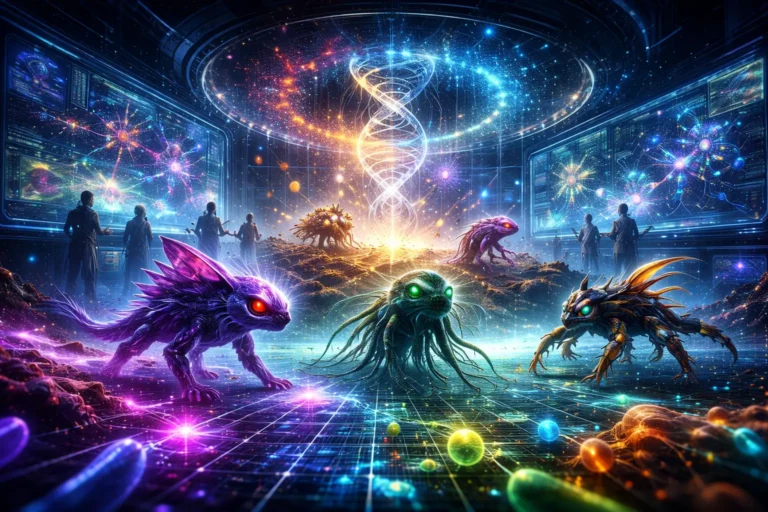
For decades, researchers have used computers to imitate life’s evolution. These programs create digital organisms with virtual “genes” and let them compete, adapt, fail and succeed across many generations. Think of it like a digital nature reserve where evolution runs on its own clock, sometimes for thousands or millions of simulated years.
One group of scientists recently took this idea further than ever before. Instead of just one world or one set of conditions, they ran their simulated evolution across 105 different environments. Each environment changed over time — shifting temperatures, cycles of scarcity and abundance, and varied challenges that mirrored how planets and ecosystems change over millions of years. These virtual organisms had to adapt or fade away across every one of those settings.
The expectation was simple: evolution would find ways to make creatures better at surviving, just as it has on Earth. But the outcome was far more interesting.
The surprise that rewrote assumptions
What scientists found was unexpected in three big ways:
1. Evolution doesn’t always follow the same path
In simple simulations, it’s easy to assume evolution will lead to predictable improvements — clearer strategies, better mobility, smarter behavior. But in these 105 environments, evolution took wildly different paths. In some cases, the virtual creatures didn’t just evolve to survive — they evolved to thrive in ways researchers could not have guessed.
For example, in environments that changed unpredictably, organisms developed traits that were not strictly “better” in the classic sense but were flexible. They could cope with many different challenges rather than mastering just one. This kind of generalist evolution is something researchers are still trying to understand.
2. The order of environmental change mattered
Not only did the creatures adapt differently, the sequence in which environmental conditions changed shaped the outcomes profoundly. If drought came first followed by heat, the evolution ended up looking very different than if heat came first followed by drought. This tells us that evolution is not just about the end conditions, but the path taken to get there.
3. Some virtual creatures found strange, ingenious solutions
In earlier evolution projects — ones where computers were asked to evolve creatures for specific tasks — digital organisms sometimes discovered clever “shortcuts.” In one famous set of experiments from almost three decades ago, virtual creatures learned to fall over in a way that helped them move faster — an unexpected trick that outperformed many deliberate designs.
Those earlier findings hinted that simulated evolution could be more creative than scientists assumed. The new study amplified that idea by showing broad variability and surprising resilience across many simulated worlds.
Why these unexpected outcomes matter
You might wonder: why should we care about digital creatures evolving on a computer? The answer goes deeper than pixels and algorithms.
Rethinking life’s adaptability
For centuries, biologists have understood evolution as a process guided by natural selection acting on random variation. But these simulations show that context — the environment’s rhythm, pace and sequence of change — can shape life’s outcomes in ways we did not fully grasp.
This suggests that life on Earth may have been shaped by far more historical chance than we recognize. And if that’s true here, it might be true elsewhere.
New models for biology
Biological experiments in labs or in nature are limited by time and scale. Millions of years of evolution cannot be observed directly. But digital evolution lets scientists explore those timescales compressed into hours or days. The unexpected results offer clues about how real organisms might evolve under conditions far different from Earth’s stable climate.
This is particularly interesting for astrobiology — the study of life beyond Earth. It challenges the idea that life must evolve in Earth-like ways or follow predictable patterns. New models could help us imagine life on worlds with shifting climates, weak gravity, or very long days.
Impacts beyond biology
Interestingly, the researchers noted parallels between biological evolution and how artificial intelligence learns. In both cases, systems must adapt to change without forgetting what they learned before. The unexpected results from evolution simulations might offer fresh insights into how learning systems, including AI, could become better and more flexible.
How the simulations were set up
At the heart of these experiments are digital organisms — bits of code representing a body and a set of growth or survival instructions. Each organism is evaluated in a virtual world where it must try to survive, reproduce, or complete tasks. Those that do better are more likely to “reproduce” — passing on their digital DNA with small changes or mutations.
When scientists run thousands or millions of generations of these digital beings, surprising things can happen. Unexpected behaviors can emerge, just as unexpected species evolved on our planet.
Earlier projects in this field showed that even simple evolutionary rules can produce creatures with complex motion and behavior, from swimming and walking to flipping and balancing — all developed without anyone telling the digital organism how to do it.
In the latest research, the added complexity of many different environments multiplied the potential outcomes, leading to results researchers had not planned for.
What scientists are still trying to understand
The findings opened more questions than they answered. Some of the puzzles include:
- Why do certain environments spur more creative evolution?
- What role does randomness play versus structured change?
- Can these findings guide us toward discovering real life beyond Earth?
- How do real ecosystems on very different planets evolve if conditions shift unpredictably?
Scientists are racing to explore these questions through more simulations, lab experiments, and comparisons with real biological systems.
FAQs
Q: Did these simulations create real alien life?
A: No. These were digital simulations, not biological experiments. They produced virtual organisms inside computers designed to test how evolution responds to change. They are tools for understanding how life might behave, not real alien beings.
Q: Are the results relevant to Earth’s evolution?
A: Yes. They offer clues about how real evolution can be shaped by changing conditions and history, not just by single factors. This could help refine our understanding of life’s past on Earth.
Q: Could this help find life on other planets?
A: It could. The research suggests evolution might take many paths in different conditions. That broadens what scientists might consider when looking for biosignatures on planets very different from Earth.
Q: Does evolution on a computer reflect real biology?
A: Simulations simplify reality, but they capture key mechanics of evolution. They provide a safe, controlled way to study long-term patterns that are impossible to watch directly in nature.
How these discoveries might change science
The biggest impact may be philosophical. For a long time, scientists have debated how predictable evolution is. Does it always lead to complexity? Does it always favor certain traits? These new results show the answer may be more complex.
Evolution, as revealed in digital tests, depends heavily on the sequence of changes and the environment’s history. That means even simple systems can take unpredictable paths, and outcomes we think are unlikely might actually be possible under the right conditions.
This shifts how we imagine life — both here on Earth and on distant worlds. It invites us to expect the unexpected.
A cautionary note
While these results are exciting, simulations are still models. They don’t replicate every detail of real chemistry or ecology. They simplify many things to focus on core evolutionary principles. Real life involves messy processes — from genetics to ecosystems — that computers can’t fully mimic.
The discoveries reveal patterns and possibilities, not certainties. But they do expand the realm of what science considers possible.
Sources and reference URLs
Here are the verified scientific sources that informed this article. These are for proof, accuracy, and further exploration:
- ScienceDaily — Scientists replayed evolution and found a surprise:
https://www.sciencedaily.com/releases/2025/12/251226045324.htm - Karl Sims — Evolved Virtual Creatures digital evolution research:
https://www.karlsims.com/evolved-virtual-creatures.html - Archived research on virtual creatures and artificial evolution:
https://www.sci.brooklyn.cuny.edu/~sklar/teaching/s10/alife/papers/sims-siggraph94.pdf - LinkedIn explanation of unexpected simulated evolution results (early digital evolution experiments):
https://www.linkedin.com/pulse/do-somersault-barrel-roll-when-ai-surprised-results-fraser-stevens - Framsticks — artificial life simulator background:
https://en.wikipedia.org/wiki/Framsticks - Xenobot — virtual designed organisms (context for artificial evolution systems):
https://en.wikipedia.org/wiki/Xenobot

0 Comments