

















Important Disclaimer
This article explains scientifically documented magnetic anomalies and navigation incidents. It does not promote supernatural claims. Compass disturbances are real physical phenomena caused by Earth’s magnetic field variations, mineral deposits, solar activity, and geological structures. All information is based on publicly available scientific research and government data. Verified reference URLs are listed at the end of the article.
When the Needle Refuses to Point North
For centuries, sailors trusted a simple tool: a magnetized needle floating freely, always pointing north. The compass built empires. It guided ships across unknown seas and helped explorers cross continents.
But there are places on Earth where that needle does not behave the way it should.
It swings without warning. It drifts slowly away from true direction. It points somewhere no map expects.
And it does this not once, not randomly, but consistently.
These are not myths. They are real geographic regions where the Earth’s magnetic field behaves differently — sometimes dramatically so.
Understanding why compasses fail in these places reveals something far more fascinating than legend: our planet itself is alive with shifting magnetic forces.
The Bermuda Triangle — Mystery and Measurement
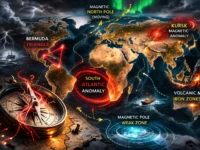
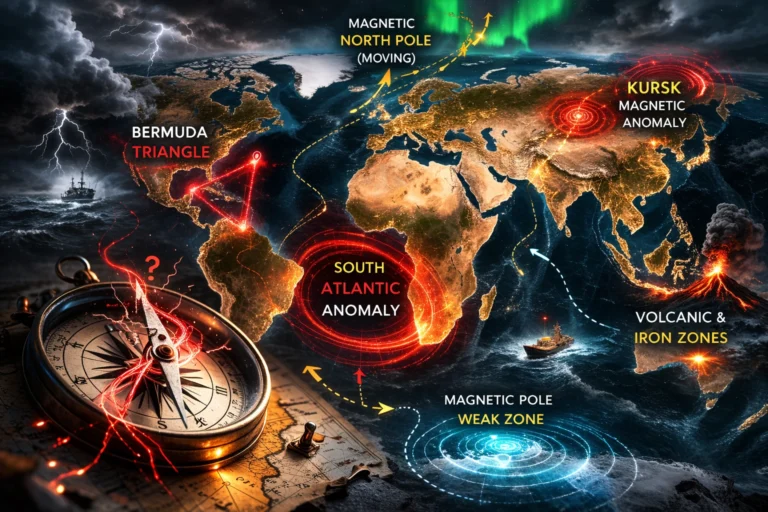
The most famous example is the Bermuda Triangle, the area roughly between Miami, Bermuda, and Puerto Rico.
For decades, stories claimed compasses spun wildly here. Pilots reported instruments behaving strangely. Ships vanished. Headlines fueled fear.
But what is the truth?
The Bermuda Triangle lies near a region where magnetic north and true north once aligned more closely than in many other parts of the world. This alignment, called an agonic line, means a compass points to geographic north without correction.
In the past, navigators unfamiliar with magnetic variation may have miscalculated their routes when crossing into or out of this region.
Scientific reviews by the U.S. Coast Guard and National Oceanic and Atmospheric Administration have found no evidence of unusual magnetic behavior unique to the Triangle compared to other parts of the ocean.
However, local magnetic variation and strong weather systems have historically contributed to navigation errors.
The compass didn’t fail because of the supernatural.
It failed because humans misunderstood how magnetic declination works.
The South Atlantic Anomaly — Earth’s Weak Magnetic Spot
Far more dramatic than the Bermuda Triangle is the South Atlantic Anomaly (SAA).
This region stretches over parts of South America and the southern Atlantic Ocean. Here, Earth’s magnetic field is significantly weaker than average.
The anomaly does not just affect compasses. It affects satellites.
Space agencies have documented increased radiation exposure to spacecraft passing through this region because Earth’s protective magnetic shield dips lower there.
The compass needle may not spin wildly at sea level, but the magnetic intensity is measurably lower.
Why?
Scientists believe it is linked to complex flows of molten iron in Earth’s outer core. The magnetic field is generated by this movement. It is not fixed. It shifts over time.
The South Atlantic Anomaly is growing and slowly drifting westward, according to NASA and ESA measurements.
This is not a temporary glitch. It is a dynamic feature of our planet’s magnetic system.
The Magnetic North Pole — A Moving Target
Compasses do not point to the geographic North Pole. They point to the magnetic north pole.
And that pole moves.
In fact, over the last two decades, it has been moving faster than at any recorded time in modern history, shifting from northern Canada toward Siberia.
This movement forces periodic updates to the World Magnetic Model, used by military navigation systems, aircraft, and GPS backup systems worldwide.
In high Arctic regions, compass readings can become unreliable because magnetic field lines dip steeply downward into the Earth.
Explorers in these regions rely on gyroscopic instruments rather than traditional compasses.
In short: near the magnetic poles, the compass struggles because the magnetic field is vertical, not horizontal.
Volcanic Regions and Iron-Rich Terrain
Certain land areas consistently disrupt compasses due to geology.
Large deposits of magnetite or iron-rich rocks can locally distort magnetic readings.
Iceland’s volcanic terrain, parts of northern Canada, and regions of Western Australia have recorded local magnetic anomalies.
In these areas, a handheld compass may deviate several degrees from expected direction.
The effect is usually small, but for precision navigation, even a few degrees matter.
The reason is simple: the compass responds to nearby magnetic sources as well as Earth’s core-generated field.
In mountainous or mineral-rich terrain, the needle can favor local magnetic forces.
The Kursk Magnetic Anomaly — Russia’s Iron Giant
One of the largest magnetic anomalies on land is the Kursk Magnetic Anomaly in western Russia.
It is caused by one of the world’s largest iron ore deposits.
Surveyors have measured strong local magnetic variations here for decades.
The anomaly is so significant that it played a role in early 20th-century geological exploration.
In such regions, compasses are not useless, but they must be used carefully, often with cross-checks against maps and astronomical bearings.
Solar Storms — When the Sun Interferes
Compass failures are not always geographic.
Sometimes they are cosmic.
During intense solar storms, charged particles from the Sun disturb Earth’s magnetosphere. These geomagnetic storms can temporarily alter magnetic readings.
In extreme cases, navigation systems and power grids have been disrupted.
The Carrington Event of 1859 remains the most famous example of solar interference. Telegraph systems failed. Auroras appeared near the equator.
If such an event occurred today, compass deviations would likely accompany broader technological disruption.
Solar activity remains one of the few external forces capable of temporarily disturbing Earth’s magnetic stability on a global scale.
The Agonic Line — Where Compass and True North Align
There are also places where compasses behave perfectly.
Along the agonic line, magnetic declination is zero.
This line shifts over time and moves across continents.
At moments in history, parts of the eastern United States and western Europe sat along it.
Navigators crossing this invisible boundary sometimes miscalculated corrections, believing something was wrong with their instruments.
The compass was working correctly.
Human interpretation was not.
Modern Navigation and Why Compass Errors Still Matter
You may wonder: in the age of GPS, does this even matter?
Yes.
Aircraft, naval vessels, and military systems still use magnetic heading references.
Backup navigation procedures rely on compass readings.
Even smartphones contain magnetometers that can be influenced by local magnetic interference.
Understanding where compasses fail consistently helps engineers calibrate systems and update global magnetic models.
Earth’s magnetic field is not static. It is evolving.
Some researchers even study whether the South Atlantic Anomaly is connected to a long-term weakening of the field — a phenomenon that could precede a magnetic pole reversal.
There is no evidence such a reversal is imminent, but geological records show it has happened many times over Earth’s history.
If it happens again, compass behavior worldwide would change dramatically for centuries.
Separating Myth from Measured Reality
The idea of a compass spinning wildly captures imagination.
But the truth is more grounded.
In most so-called “mysterious” regions, compasses do not spin out of control. They drift gradually. They require correction. They reflect Earth’s magnetic variation.
Real compass failure occurs in predictable conditions:
- Near magnetic poles
- Over strong mineral deposits
- Within known magnetic anomalies
- During intense solar storms
These are measurable, repeatable phenomena.
They are not supernatural.
They are physics.
FAQs
Q: Does the Bermuda Triangle actually cause compass failure?
No verified scientific data shows unique compass malfunction specific to that region. Magnetic variation exists there, as it does worldwide, but no extraordinary anomaly has been confirmed by major agencies.
Q: Can the South Atlantic Anomaly affect ships at sea?
At sea level, effects are minimal for standard compasses. The anomaly mainly affects satellites due to increased radiation exposure in orbit.
Q: Why does magnetic north move?
Earth’s magnetic field is generated by molten iron moving in the outer core. As those flows change, the magnetic poles shift.
Q: Can a solar storm make my compass useless?
During strong geomagnetic storms, temporary deviations may occur, but everyday solar activity does not typically disrupt standard compasses.
Q: Is Earth’s magnetic field weakening?
Measurements show localized weakening, especially in the South Atlantic region. Scientists continue monitoring the trend, but there is no confirmed immediate danger.
Conclusion — A Planet in Motion
The places where compasses fail consistently are not portals or cursed waters.
They are windows into Earth’s interior.
They remind us that beneath our feet, liquid metal flows. Above our heads, solar winds collide with invisible shields. Around us, invisible lines of force curve and shift.
The compass remains one of humanity’s simplest yet most profound inventions.
When it falters, it is not magic.
It is Earth reminding us that even the ground we trust is part of a dynamic, moving system.
And that may be far more astonishing than any legend.
Reference URLs
- NOAA National Centers for Environmental Information — World Magnetic Model
https://www.ncei.noaa.gov/products/world-magnetic-model - NASA Earth Observatory — South Atlantic Anomaly
https://earthobservatory.nasa.gov/features/SouthAtlanticAnomaly - European Space Agency — Swarm Mission and Magnetic Field Data
https://www.esa.int/Applications/Observing_the_Earth/Swarm - U.S. Geological Survey — Geomagnetism Program
https://www.usgs.gov/programs/geomagnetism - NOAA Space Weather Prediction Center — Geomagnetic Storms
https://www.swpc.noaa.gov - National Ocean Service — What is Magnetic Declination?
https://oceanservice.noaa.gov/facts/declination.html

0 Comments