













By Ronald Kapper
A Strange Idea That Refuses to Go Away
For centuries, humans believed reality was exactly what it looked like — solid, physical, unquestionable. But modern physics has slowly chipped away at that certainty. Quantum mechanics revealed a universe built from probabilities. Information theory suggested reality may be made of data. And now, a new physics framework is asking a bold question:
What if the universe behaves like code?
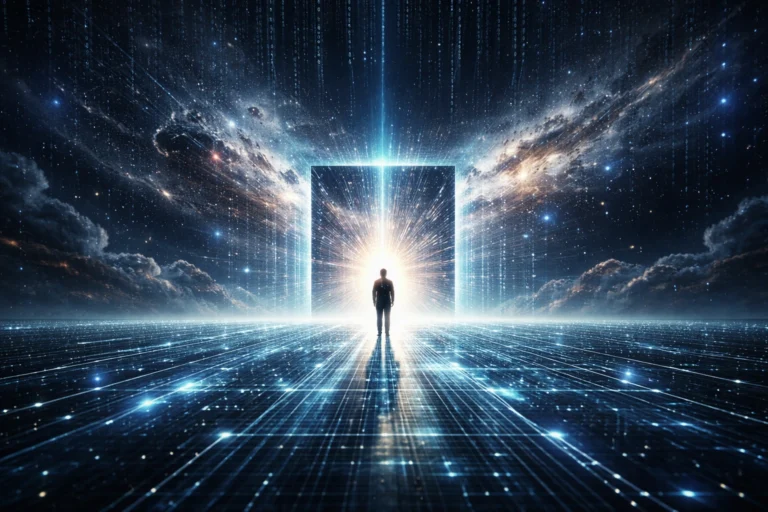
This does not mean we are inside a video game or computer screen. But some scientists argue that reality may operate through informational rules — similar to how software governs digital worlds. The idea is controversial, debated, and far from proven. Yet it has moved from philosophy into serious scientific discussion.
The Physics Behind the “Code” Universe
The foundation of this idea goes back to physicist John Wheeler’s famous phrase: “It from bit.” The suggestion was simple but powerful — physical reality may arise from information, not matter.
In modern research, some scientists propose that space, time, and matter behave like informational structures rather than continuous physical substances. In this view, the universe could operate like a computational system where reality evolves through rules similar to algorithms.
Recent theoretical work even explores whether space-time might behave like a grid, similar to pixels in a simulation, which could leave measurable signatures in cosmic radiation.
This does not prove we live in a simulation. But it shows physics is exploring whether reality is fundamentally informational.
A New Physics Law — Information as the Core of Reality
Some recent proposals go further. Physicist Melvin Vopson suggested a new law connecting physics and information, sometimes called infodynamics. The idea proposes that information behaves like a physical quantity and may shape how the universe evolves.
In simplified terms, this view suggests:
- Reality may be built from information patterns
- Physical laws may organize and compress information
- Gravity and entropy might behave like computational processes
Such ideas remain speculative, but they push physics into new territory — treating reality less like matter and more like structured information.
The Simulation Hypothesis — A Radical Interpretation
The simulation hypothesis takes the informational universe idea one step further. It proposes that reality might not be base reality but a constructed environment — similar to a highly advanced simulation.
This idea gained attention after philosopher Nick Bostrom argued that if civilizations become technologically powerful enough, they could simulate entire universes, making simulated realities potentially more common than physical ones.
From a purely logical standpoint, some scientists argue that if such simulations are possible, we cannot rule out the possibility that we are inside one.
But possibility is not proof.
Can Science Test the Simulation Idea?
One of the biggest criticisms of the simulation concept is that it may not be testable. Science relies on measurable predictions. If reality were simulated, could we detect it?
Some researchers propose potential clues:
- Discrete or grid-like space-time structure
- Limits in computational complexity of the universe
- Anisotropies in cosmic radiation patterns
These are not confirmations, only possible indicators proposed for testing the hypothesis.
So far, none of these tests has confirmed that reality is simulated.
Not All Scientists Agree
In fact, some physicists argue the opposite — that the universe cannot be a simulation at all. Recent mathematical research using Gödel’s incompleteness theorem suggests reality contains non-algorithmic elements that cannot be reproduced by computation.
If true, this would mean a simulated universe could never fully replicate our own.
This highlights an important truth: the simulation concept remains an open scientific debate, not an established fact.
The Information Universe — Reality as Data
Another branch of physics explores whether the universe behaves like a quantum information system. In this framework:
- Particles are informational states
- Quantum mechanics encodes reality as probabilities
- Physical laws resemble data processing rules
This informational view does not necessarily imply simulation. It simply suggests that information may be the most fundamental building block of existence.
Some researchers even describe the universe as behaving like a quantum computer processing information through physical laws.
The Holographic Universe — Reality as Projection
A related concept proposes that reality might function like a hologram. In this idea, the three-dimensional world we experience could emerge from information stored on a two-dimensional boundary.
Studies of cosmic radiation and quantum gravity models have explored this possibility, suggesting reality may be more like encoded information than physical substance.
Again, this does not prove simulation — but it strengthens the idea that reality may not be as straightforward as it appears.
The Probability Question — Could We Be Simulated?
Some researchers have attempted to estimate the probability of living in a simulation. One analysis suggested the probability might not be as high as often claimed, especially if simulations cannot run indefinitely or recursively.
Other scientists argue the probability question itself may be meaningless without evidence.
The truth: we do not yet know.
What This Means for Humanity
If reality is informational, simulated, or fundamentally coded, the implications would be enormous:
- Reality might be more flexible than we think
- Consciousness might interact with information rather than matter
- Physics could unify information, energy, and space-time
But until evidence appears, these remain ideas — not confirmed discoveries.
FAQs
Q1: Does science prove we live in a simulation?
No. There is no confirmed scientific evidence that reality is simulated.
Q2: What does “universe has code” mean?
It means some physicists think reality may operate through informational rules similar to computation.
Q3: Is the simulation hypothesis accepted by scientists?
It is debated. Some support exploring it, others reject it based on physics and mathematics.
Q4: Could we ever know for sure?
Possibly — if measurable evidence appears. Right now, the idea remains theoretical.
Q5: Does this replace physics?
No. These ideas are part of ongoing attempts to understand the deepest structure of reality.
The Balance Between Wonder and Evidence
The idea that reality might be informational — or even simulated — captures imagination because it touches something profound: the nature of existence itself.
Yet science moves carefully. Extraordinary claims require extraordinary evidence. Today, the informational universe remains a fascinating possibility, not a proven truth.
Still, one fact remains: physics continues to discover that reality is stranger, deeper, and more mysterious than we ever imagined.
Disclaimer
This article discusses scientific hypotheses and theoretical models. It does not claim that reality is proven to be a simulation. Many scientists reject or question the simulation hypothesis. The topic remains an open area of philosophical and scientific exploration.

0 Comments