


















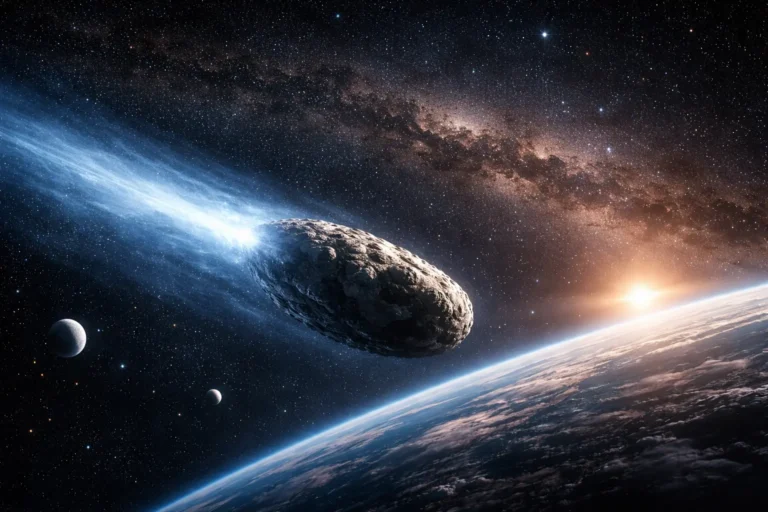
Another visitor from deep space has come and is now preparing to leave.
The object known as 3I/ATLAS was identified as an interstellar body passing through our solar system, making it only the third confirmed object of its kind ever recorded. Unlike ordinary comets that orbit the Sun, 3I/ATLAS arrived from beyond our solar neighborhood. Its path was hyperbolic, meaning it was never gravitationally bound to the Sun. It came from the darkness between stars and is now heading back out.
Most astronomers describe it as a natural comet. Harvard astrophysicist Avi Loeb is not fully convinced that the conversation should end there.
As 3I/ATLAS drifts farther away, Loeb has raised a simple question: Did we miss something important while it was here?
What Is 3I/ATLAS?
The designation “3I” stands for the third confirmed interstellar object observed passing through our solar system. The discovery was made through the ATLAS survey system, which scans the sky for near-Earth objects.
The first known interstellar visitor was ‘Oumuamua in 2017. The second was comet 2I/Borisov in 2019. Both sparked intense scientific interest because they offered a rare chance to study material formed around other stars.
3I/ATLAS followed in their path, though with less public drama. Early measurements indicated that it displayed characteristics typical of a comet. It showed activity consistent with outgassing, which is the release of gas as ice heats up near the Sun.
Yet as with previous interstellar objects, certain details left room for debate.
Avi Loeb’s Perspective
Avi Loeb, a professor of astrophysics at Harvard University, became widely known after proposing that ‘Oumuamua might have been artificial in origin. That claim sparked controversy within the scientific community. Many researchers disagreed, citing natural explanations.
With 3I/ATLAS, Loeb has been more measured but remains open to unconventional possibilities. He has argued that interstellar objects deserve thorough scrutiny because they represent samples from other star systems.
His concern is not necessarily that 3I/ATLAS is artificial. Rather, he believes scientists must avoid dismissing anomalies too quickly.
Loeb has pointed out that brief observational windows limit our understanding. Interstellar objects move fast. By the time telescopes focus in detail, the object is already retreating.
In his view, time pressure increases the risk that subtle data could be overlooked.
What Did Scientists Observe?
Astronomers tracked 3I/ATLAS using ground-based telescopes and orbital instruments. Spectral analysis suggested typical cometary composition. Its brightness changes appeared consistent with dust and gas emission.
Unlike ‘Oumuamua, which showed unusual acceleration not fully explained at first, 3I/ATLAS did not display dramatic deviations from expected comet behavior. That fact led many researchers to classify it as an ordinary interstellar comet.
However, ordinary does not mean unimportant.
Studying 3I/ATLAS helps scientists understand how planetary systems form around distant stars. Its chemical makeup offers clues about environments far beyond our reach.
The object’s speed and trajectory confirmed that it originated outside our solar system. That alone makes it scientifically valuable.
The Narrow Window of Opportunity
One of the central concerns raised by Loeb involves timing. Interstellar objects travel at high velocities relative to the Sun. Observational campaigns must be organized quickly.
Unlike spacecraft missions that can revisit targets, astronomers get one chance. If instruments are not positioned optimally or weather interferes with observations, the opportunity narrows.
3I/ATLAS approached the Sun, brightened slightly, and then began its outbound journey. As it moves farther away, it becomes fainter and harder to study.
Loeb argues that future detection systems should identify such objects earlier. Earlier detection would allow deeper analysis, including potential space missions designed to intercept them.
Why Interstellar Objects Matter
Every comet from another star system carries a record of its birthplace. The dust and ice inside 3I/ATLAS likely formed around a distant star long before Earth existed.
By analyzing such material, scientists can compare chemical compositions across planetary systems. Are organic molecules common? Is water ice abundant? Are building blocks of life widespread?
These questions extend beyond curiosity. They shape our understanding of how common life might be in the universe.
Loeb emphasizes that interstellar visitors provide physical evidence, not just distant light signals.
The Debate Over Caution and Curiosity
The broader scientific community tends to favor conservative explanations. Extraordinary claims require strong evidence. That standard protects science from speculation.
At the same time, exploration requires curiosity. If unusual features appear, they must be examined carefully.
Loeb’s critics argue that suggesting artificial origins without strong proof risks distracting from solid research. Loeb counters that science advances by questioning assumptions.
With 3I/ATLAS, the debate has been less heated than with ‘Oumuamua. Still, the conversation highlights a larger issue: how quickly should scientists close the book on anomalies?
What We May Have Missed
The possibility that something was overlooked does not imply conspiracy or secrecy. It reflects the limitations of observation.
Spectroscopy can detect certain molecules but may miss trace compounds. Surface features cannot be resolved in detail from vast distances. Internal structure remains unknown.
Without sending a probe, scientists must rely on light and motion.
Loeb suggests that future missions should be prepared in advance so that when the next interstellar visitor arrives, a spacecraft can be launched rapidly.
He argues that interstellar objects could carry surprises, and preparation should match that potential.
A Responsible Disclaimer
There is no verified evidence that 3I/ATLAS is artificial or technologically constructed. Most astronomers describe it as a natural comet from another star system.
Avi Loeb’s perspective reflects scientific debate rather than confirmed findings. His call for deeper investigation does not equate to proof of hidden origin.
Responsible reporting requires distinguishing between hypothesis and established data.
The Future of Interstellar Detection
New survey systems are being developed to scan the sky more efficiently. The Vera C. Rubin Observatory, for example, is expected to increase the rate of transient object discovery.
As detection improves, scientists anticipate identifying more interstellar visitors.
Each object will present new data and new questions. The goal is not to prove a theory but to expand understanding.
If 3I/ATLAS has already slipped beyond reach, the lesson may be one of preparation rather than regret.
Frequently Asked Questions
What is 3I/ATLAS?
It is the third confirmed interstellar object observed passing through our solar system.
Is there proof it was artificial?
No. There is no confirmed evidence supporting an artificial origin.
Why does Avi Loeb question conventional explanations?
He believes interstellar objects deserve thorough investigation and that unusual features should not be dismissed prematurely.
Can we send a mission to intercept such objects?
In theory, yes, but rapid response capability would need to be developed in advance.
Why are interstellar objects important?
They provide direct samples of material formed around other stars, offering insight into planetary formation beyond our solar system.
Conclusion
3I/ATLAS is leaving our solar system. As it fades into the distance, the scientific record it leaves behind will be analyzed for years.
For most astronomers, it was a natural comet that briefly crossed our path. For Avi Loeb, it represents a reminder that the universe still holds unknowns.
Whether 3I/ATLAS carried any secret remains uncertain. What is certain is that the next interstellar visitor will come.
The question is whether we will be ready.
Sources and Reference Material
NASA Solar System Exploration – Small Bodies and Interstellar Objects:
https://solarsystem.nasa.gov/
Minor Planet Center – Interstellar Object Announcements:
https://www.minorplanetcenter.net/
Harvard University Department of Astronomy – Faculty Publications:
https://astronomy.fas.harvard.edu/
ATLAS Survey Project Information:
https://atlas.fallingstar.com/
NASA Jet Propulsion Laboratory – Near-Earth Object Observations:
https://www.jpl.nasa.gov/

0 Comments