

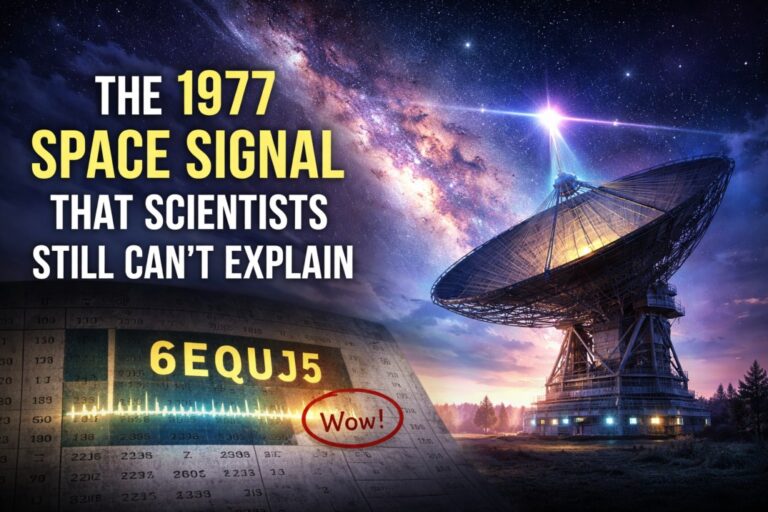

The 1977 Space Signal That Scientists Still Can’t Explain
On a quiet night in August 1977, a radio telescope in Ohio caught something that still makes scientists sit up straight.
It wasn’t a blurry photo. It wasn’t a strange light in the sky. It was a clean, narrowband radio signal—strong, sharp, and oddly “well-behaved”—as if it came from something deliberately transmitting. And then it vanished.
A few days later, while reviewing a long sheet of computer printout, volunteer astronomer Jerry Ehman circled a peculiar sequence—6EQUJ5—and wrote a single word in the margin: “Wow!”
Nearly five decades later, the Wow! signal remains famous for one brutal reason: it has never been heard again.
The moment the universe “knocked”
The signal was detected by Ohio State University’s “Big Ear” radio telescope, a facility that ran one of the longest continuous searches for extraterrestrial intelligence.
Here’s what made that night different:
- Date: August 15, 1977
- Duration: about 72 seconds—exactly the length Big Ear could observe a fixed spot as Earth rotated
- Location in sky: near the constellation Sagittarius
- Frequency region: near the hydrogen line around 1420 MHz, a part of the spectrum often discussed in SETI circles because hydrogen is the most abundant element in the universe
Big Ear wasn’t “pointing” like a modern dish. It used the planet itself as a scanner—letting the sky drift through its field of view. That’s why the Wow! signal’s timing matters so much: the rise and fall of the signal strength looked like a source drifting through the telescope’s beam, not like random interference popping in and out.
6EQUJ5: the code that launched a thousand theories
The famous string 6EQUJ5 is not a message, and it isn’t a secret alien alphabet. It’s simply how the system logged signal intensity over consecutive samples—basically, a quick “strength score” printed as numbers and letters.
That detail matters because it undercuts a lot of social-media myths. The mystery isn’t that someone “decoded” a transmission. The mystery is simpler and tougher:
A strong, narrowband signal appeared where it shouldn’t… and never came back.
Why scientists took it seriously (and still do)
Plenty of odd signals get tossed out as human-made interference. The Wow! signal stayed on the table because it checked several boxes that made SETI researchers pay attention:
- Narrowband nature
Many natural astrophysical sources produce broad, messy emissions. A tight, narrowband signal is more suggestive of technology (though not proof). - Right “neighborhood” on the dial
The signal appeared near the 1420 MHz hydrogen line, a region long discussed as a logical “hailing frequency” because hydrogen is universal. Ohio State researchers note that this is one reason it stood out so sharply. - A clean 72-second window
The duration matched Big Ear’s observation window for a fixed point in the sky—exactly what you’d expect from a distant source drifting through the beam.
And then came the most frustrating part: follow-up searches—many of them—came up empty.
The theories: satisfying stories, unsatisfying evidence
Over the years, proposed explanations have ranged from sensible to cinematic. A few come up repeatedly because they almost fit.
1) A local Earth source (interference)
A lot of “mystery signals” end here. But with Wow!, researchers never pinned down a specific terrestrial transmitter, and the signal’s characteristics didn’t neatly match a known local pattern.
2) Space debris reflections
Even Ehman considered whether a terrestrial signal could have bounced off something in space. The problem is that it requires a very particular geometry and circumstances—plausible in principle, hard to prove in practice.
3) A natural astrophysical source
There are published attempts to explain Wow! with natural mechanisms, and modern researchers continue to revisit archival data and possible astrophysical scenarios.
But the biggest obstacle remains: no repeat detection. Science loves repeatability. Wow! refuses to cooperate.
4) The comet hypothesis
In the 2010s, an astronomer suggested hydrogen clouds around comets could be responsible, and it gained attention in popular science coverage.
However, Ohio State’s own discussion of the mystery has been blunt about how hard it is to make a comet explanation stick with the available evidence and sky context. As Ohio State graduate researcher Molly Gallagher put it: “It’s not a comet.”
The quote that defines the problem
The Wow! signal sits in a painful category: fascinating enough to remember, thin enough to doubt, lonely enough to never close the case.
SETI Institute astronomer Seth Shostak summed up the core frustration in a single line: “If they can’t find it again… all we can say is, ‘Gosh, I wonder what it was.’”
That’s the scientific nightmare—and the public’s dream. One unrepeatable event can live forever.
Why it “explodes” in the mind: parallel reality, without the multiverse word
Here’s the strange psychological twist: the Wow! signal forces two realities to coexist.
In one reality, it was a glitch, interference, or a rare natural event—something ordinary wearing an extraordinary mask.
In the other, it was a genuine technological beacon—an accidental overshare from something out there, heard once because the timing was perfect, and missed forever because the cosmos doesn’t do encores on demand.
That mental split is why the Wow! signal keeps resurfacing in documentaries, debates, and late-night conversations. It’s a scientific event that behaves like a story cliffhanger.
And the cliffhanger is real.
FAQs
Was the Wow! signal confirmed as aliens?
No. It has never been confirmed as extraterrestrial technology, and no explanation—alien or otherwise—has been proven.
Why was the hydrogen line such a big deal?
Hydrogen is the most common element in the universe. Researchers have long suggested that if an intelligence wanted a universal “meeting point” on the radio dial, frequencies near hydrogen’s emission line might be a logical choice.
If it was real, why didn’t it repeat?
Possibilities include: the source was transient, it was directional and didn’t sweep past Earth again, the timing depended on Earth’s rotation and a narrow beam, or it wasn’t an intentional transmission at all. Follow-up searches have repeatedly found nothing.
Has new research changed what we know?
Researchers continue to re-examine archival data and propose updated interpretations, including recent technical re-analyses of the signal’s properties.
Where is the original printout today?
Images and reproductions of the printout (with “Wow!” written in the margin) have been widely published and discussed in official Ohio State coverage and historical materials tied to Big Ear.
Disclaimer for Google News compliance
This article discusses a historically documented astronomical event (the “Wow!” signal) and summarizes publicly available scientific commentary and hypotheses. No claim is made that the signal was extraterrestrial in origin. The cause remains unconfirmed.
Reference links:
https://artsandsciences.osu.edu/news/did-ohio-state-really-detect-alien-signal-0
https://www.bigear.org/Wow30th/wow30th.htm
https://www.space.com/33904-seti-mystery-signal-wow-alien-message-debate.html
https://arxiv.org/pdf/2508.10657
https://arxiv.org/html/2408.08513v2
https://en.wikipedia.org/wiki/Wow%21_signal

0 Comments